ME6260 (058:260) Viscous Flow
Spring 2026
Instructor: Professor Frederick Stern frederick-stern@uiowa.edu
TA: Christian Milano christian-milano@uiowa.edu
Time/Location: TTH, 09:30 – 10:45 AM 2133 Seamans Center
Primary Textbook[1]:
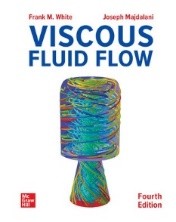
Viscous Fluid Flow, 4th Edition, ISBN10: 0073529311 | ISBN13: 9780073529318, By Frank White and Joseph Majdalani © 2022
Secondary Textbooks:
Academic Press; 6th edition (June 19, 2015), ISBN-10: 9780124059351, ISBN-13: 978-0124059351
Ronald L. Panton, First published:24 July 2013, Print ISBN:9781118013434 |Online, ISBN:9781118713075 |DOI:10.1002/9781118713075, Copyright © 2013 John Wiley & Sons, Inc.
4th Edition, First Published 2012, eBook Published 6 August 2012, DOI https://doi.org/10.1201/b12495 ,
eBook ISBN 9780429098888
Course Description
Viscous flow is at the heart of fundamental fluid mechanics and mastering its governing differential equations (GDEs), boundary conditions (BCs), exact solutions and approximations and their solutions, and stability and transition is imperative for those who wish to become experts in either theoretical or applied fluids engineering. The goal of Viscous Flow is to guide the students through the theory and its application whereby they attain competency for industrial practice and/or academic research. The most important GDEs and BCs are derived generally but ultimately with focus on incompressible constant property flows. Vorticity theorems, non-inertial reference frames, and curvilinear coordinates are described. Exact solutions include Couette, Poiseuille, gravity, unsteady, suction and injection, wind-driven, and non-linear similarity flows. Approximations and their solutions include low Reynolds number linearized creeping motion Stokes flows, lubrication, and boundary layers (including wall and free shear flows). Stability and transition include linear theory (normal modes and perturbations), Kelvin-Helmholtz, exchange of stabilities, Orr-Sommerfeld equation (inviscid and viscous parallel flows), and turbulent transition. The prerequisite for the class is introductory such as 57:020 (ENGR:2510) and intermediate such as ME:5160:0001 level fluid mechanics courses. Students are graded based on class project and homework assignments. The class website is used for lectures and provides all the class material needed other than the textbooks: ME:6260 Viscous Flow. The class is complementary to ME:7268 Turbulent Flow and other advanced fluid mechanics courses.
Syllabus, Assignments and Grading
Syllabus is attached below, including dates for lectures, reading and homework (HW) assignments, and class project. Final grade is based on HW (250) + class project (250) = 500 total points.
Project proposal: motivation, background, objective, approach, references, anticipated results.
Project outline: objective, approach, results, conclusions.
Grading: technical quality 75%; organization and presentation 25%.
UI and CoE Course Guidelines
See university guidelines (required elements of syllabi) that include specific language regarding free speech and expression, accommodations for students with disabilities, and class absences for religious holy days: https://provost.uiowa.edu/student-course-policies, which include statements regarding your attendance and academic integrity/misconduct policies, specifically stating the penalty/sanctions for academic misconduct. The College of Engineering website details the process and highlights examples of offenses against the Code of Academic Honesty.
Syllabus
Date | Assignments | Class Topics |
Week(1)
| 1.2,1.3,1.4,1.5,1.17,1.24 Due 02/16 | Chapter 1&2 Preliminary Concepts & Fundamental Equations of Compressible Viscous Flow |
| Week(2) | (4) Boundary Conditions for Viscous Flow Problems: Dr Zhaoyuan Wang (5) Vorticity Considerations for Incompressible Viscous Flow | |
| Week(3) |
| (6.1) Reference Frames and Coordinate Systems (6.2) Solution NS for 6DoF Solid Body Motions: Dr. Zhaoyuan Wang |
| Week(4) | (6.3) Curvilinear Coordinate Systems Project Proposals | |
| Week(5) | 3.2, 3.5, 3.9, 3.14, 3.17, 3.37 Due 03/09 | Chapter 3 Solutions of the Newtonian Viscous-Flow Equations Topics (1)-(4) Couette/Poiseuille/Gravity and Free Surface Flows Topic (5) Unsteady Flows |
| Week(6) | Topic (6) Suction and Injection Topic (7) Wind-Driven Topic (8) Non-Linear Similarity | |
| Week(7) | Topic (9) Stokes Flows | |
| Week(8) | Topic (10) Lubrication | |
| Week 3/16 | Spring Break | |
| Week(9) | 4.10, 4.11, 4.17, 4.18, 4.37, 4.40, 4.41 Due 04/20 | Guest Lecture: Dr. Riccardo Pellegrini Class Project Progress Presentations
|
| Week(10) | Chapter 4 Laminar Boundary Layers Topics (1)-(2) Background/Concepts, Theory, and Equations Similarity Solutions Momentum Integral Methods Boundary Layer Separation | |
| Week(11) | Topic (3) Free Shear Flows | |
| Week(12) | Additional Topics (4) | |
| Week(13) | Chapter 5 The Stability of Laminar Flows Topic (1) Background/Concepts and Theory Topic (2) Exchange of Stabilities | |
| Week(14) | Topic (3) Kelvin-Helmholtz Instability Topics (4) – (6) Orr-Sommerfeld Equation and Instability Parallel Flows | |
| Week(15) | Topic (7) Turbulent Transition and Transition Modeling | |
| 05/08 | End of Classes | |
| Class Project Final Presentations |
[1] Selected incompressible flow topics mostly without heat transfer